Killing of Gérard Duval
The Killing of Gérard Duval is the most intimate and morally shattering act of violence in All Quiet on the Western Front. It is the only killing Paul Bäumer commits with his bare hands, at close quarters, and the only one whose victim he comes to know as a man. The event transforms an abstraction—the enemy—into a named individual with a wife, a child, and a trade, and it leaves Paul permanently scarred by the recognition that he has murdered a brother. The encounter, which unfolds over many hours in a waterlogged shell-hole, becomes the novel's central crisis of conscience and the moment at which the war's dehumanizing logic is most starkly exposed and most painfully resisted.
Causes and Background
Paul volunteers for a patrol to reconnoiter the strength of the enemy position shortly after returning from leave. The patrol is a routine assignment, but Paul's psychological state is fragile. His leave at home has been a painful failure: he found himself unable to reconnect with his former life, felt estranged from his parents and his schoolmaster, and was haunted by the memory of the front. The experience has left him vulnerable. As he crawls forward alone into No Man's Land, a senseless fear seizes him. He lies in a shallow shell-hole, trembling, his forehead wet, his hands shaking, unable to move. He hears his mother's warning voice, sees the Russian prisoners leaning against the wire fence, and feels a simple animal terror of poking out his head. The patrol is not particularly risky, but it is his first since leave, and the terrain is unfamiliar. He wages a wild internal fight between the compulsion to advance and the desire to stay lying there, until the sound of his comrades' voices from the trench behind him—Kat and Albert talking—floods him with a new warmth and saves him from the loneliness and fear of death. He crawls forward again, but soon a heavy bombardment begins, and he is forced to lie huddled in a large shell-hole, his legs in water up to the belly, pretending to be dead.
What Happens
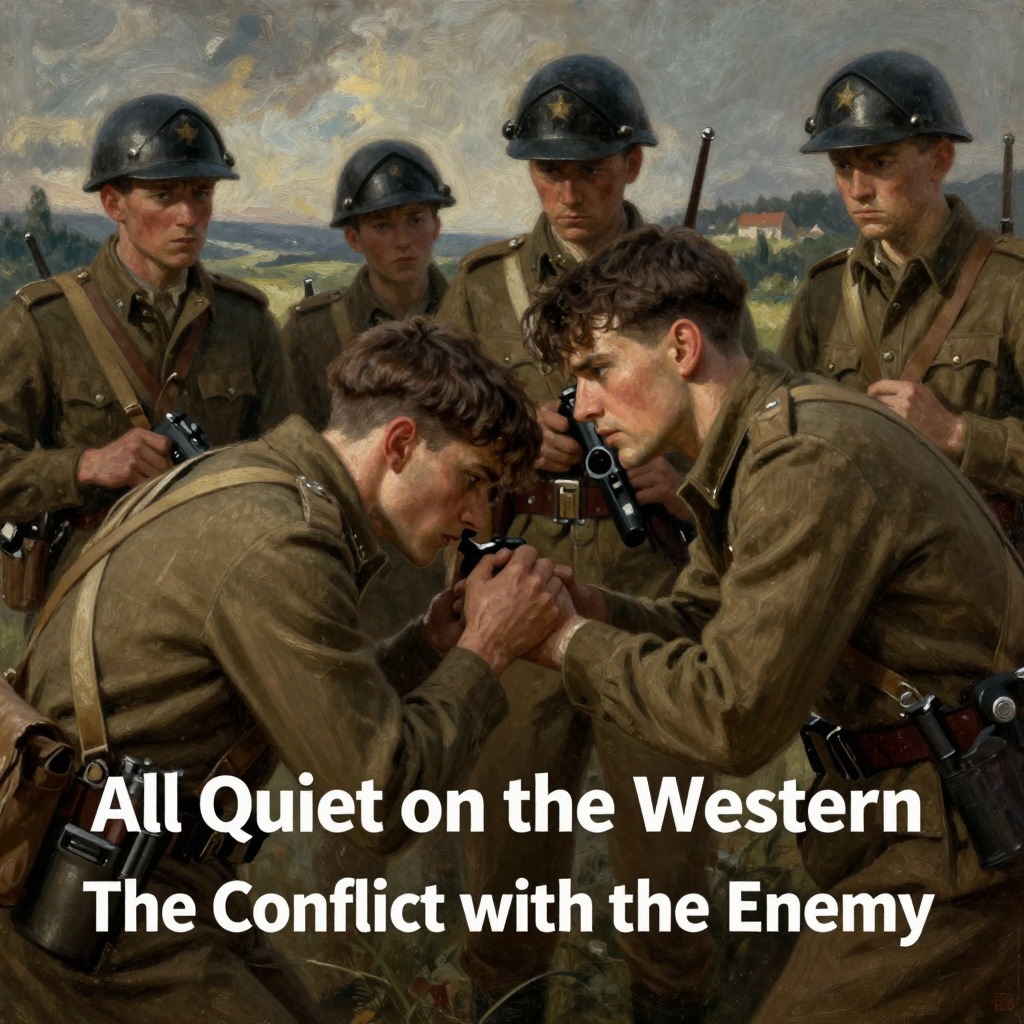
As the barrage lifts, Paul hears something clanking and stumbling nearer. A body falls over him into the shell-hole and slips down across him. Without thinking, without making a decision, Paul strikes madly with his dagger. He feels the body suddenly convulse, then go limp and collapse. When he recovers himself, his hand is sticky and wet. The man gurgles, and Paul, terrified that the sound will betray him, wants to stop his mouth, stab him again. But he cannot lift his hand. He crawls to the farthest corner of the hole, his eyes glued on the dark figure, his hand grasping the knife, ready to spring again if the man stirs. The man does not stir, but he does not die quickly. Hours pass. Paul sees him clearly in the growing light: a man with a small pointed beard, his head fallen to one side, one arm half-bent, the other hand lying bloody on his chest. The man is not dead; he is dying. Paul drags himself toward him, a terrible journey of three yards. The man opens his eyes and gazes at Paul with an expression of utter terror. Paul whispers, "No, no," and strokes his forehead. He fetches water from the mud in his handkerchief and gives it to the man to drink. He unbuttons the man's tunic to bandage his wounds, cutting the shirt open with the same knife he used to stab him. There are three stabs. Paul presses his field dressing over them. The man groans. Paul repeats the word "camerade" eagerly, trying to make him understand that he wants to help. But he knows the man cannot be saved. He wishes he had his revolver to shoot him, but he cannot stab him again. The gurgling continues. Paul fetches water again and again for the dying man and drinks some himself. At about three in the afternoon, the man dies. Paul props him up so that he lies comfortably, closes his eyes, and then, in a state of desperate agitation, opens the man's pocket-book. He finds portraits of a woman and a little girl, and letters. He reads the name: Gérard Duval, compositor. He writes the address on an envelope and thrusts everything back into the tunic. He has killed the printer, Gérard Duval.
Consequences and Aftermath
The immediate consequence is that Paul survives the patrol. Kat and Albert come out with a stretcher to look for him, and he is brought back to the trench. He tells them what happened in a few words, but he does not mention the dead printer. The next morning, he can keep it to himself no longer and tells Kat and Albert everything. They try to calm him: "You can't do anything about it. What else could you have done? That is what you are here for." Paul listens and feels comforted, reassured by their presence. He tells himself that his talk in the shell-hole was mere drivelling nonsense. But the encounter has changed him. He had promised the dead man that he would write to his wife, that he would help her and his parents and his child, that he would fight against the thing that had struck them both down. He knows, even as he makes the promise, that he will not keep it. The name Gérard Duval becomes a nail hammered into him that will never come out. The event deepens Paul's sense of being lost, of being cut off from any future. It is the first time he has killed with his hands, whom he can see close at hand, whose death is his doing. The hours beside the dying man lay his heart bare. The encounter with Duval is the novel's most powerful refutation of the official rhetoric that Paul and his comrades had been taught—the rhetoric of Kantorek and the newspapers, which spoke of the enemy as an abstraction, a monster, a beast. Paul sees that Duval is a man like himself, with a wife and a child, with the same fear of death and the same agony. The killing is not an act of heroism but a crime against a brother, and it leaves Paul with a burden of guilt and sorrow that he will carry to his own death in October 1918, on a day so quiet that the army report confined itself to the single sentence: All quiet on the Western Front.